Conventional proteins
Conventional proteins (plant- and animal-based) dominate the global and EU protein balance.
Globally, most dietary protein comes from plants (57%) (mainly wheat, corn, and rice) and secondarily, from animal-derived sources (i.e. meat (18%), dairy (10%), fish and shellfish (6%), and other animal products (9%)). In Europe, however, most dietary protein comes from animal sources (55-60%), overtaking plant-based protein since the mid-1970s.[1]
The ratio of protein needs in terms of recommended daily intake (hereafter RDI[2]) to consumption suggests overconsumption of proteins worldwide, on average, with estimates that the average daily total consumption of proteins is between 68g[3] and 80g per person.[4]
Excess consumption globally and in Europe is estimated at about one-third more than the RDI (Fig. 1). Overconsumption has also been observed in children.[5]
Figure 1: Protein consumption exceeds average estimated daily requirements in all the world’s regions, and is highest in developed countries, g/capita/day, 2009.
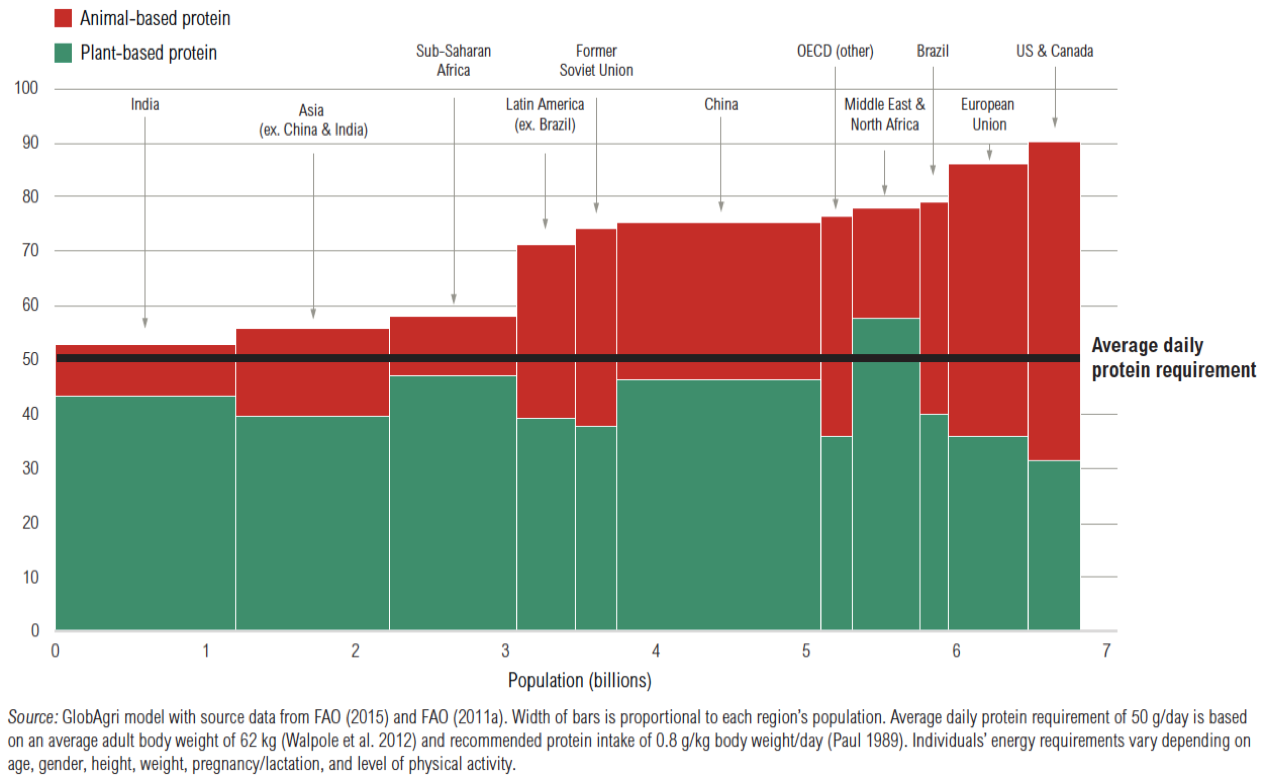
Source: Ranganathan et al. 2016. [3]
These averages mask variations: in 2022, 1 in 10 individuals were estimated to have experienced hunger, and more than 1 in 4 individuals were severely food insecure.[6]
The scale of protein deficiency within those populations is, however, poorly understood.[7] One source estimates that 662 million people were protein deficient in the world in 2018.[8]
Comparatively, the EU (alongside the US and Canada) experience low levels of food insecurity.[9] In any case, evidence of protein overconsumption in Europe on average and by a wide margin (fig.2) suggests that European diets are not protein deficient.
Analysis published in 2021 has shown that the EU is a net importer of proteins, importing an estimated 26% of the protein it consumes.[10] The principal imported sources are fish and shellfish (the EU imports more than half it consumes - Norway is the biggest supplier, with 16% of the total, all other countries exporting to the EU supplying 4% or less of the total each[11]) and feed (as discussed further below). In particular, Europeans consume imported proteins by consuming meat, dairy and eggs from animals fed with imported feed.[12]
Feed
Protein sources for feed include sources that are edible by humans (mostly grains, including cereals, and pulses) as well as non-edible sources (e.g. grass). Total global production of these sources is estimated at more than a billion tons (1171.1 MT in 2020), with over 10% produced in the EU (152.6 MT in 2020).[13]
The EU feed balance for the period 2022-2023 combines:
- crops (cereals, oilseeds and pulses; 23%),
- co-products (mostly oilseed and soya-bean meals; 33%),
- roughage (grass, silage maize, fodder leguminous; 42%),
- and a residual proportion of non-plant sources (animal proteins, former foodstuffs; 2%).
The EU is 77% self-sufficient overall for feed protein sources and fully self-sufficient in roughage, which is the main feed protein source, but lower in proteins; however, for oilseed meals, which represent 27% of total feed protein use in the EU and are high in proteins, the EU only produces 24% of what it needs to feed its livestock sector.[14] This is the European ‘feed protein deficit’,[15] which has in recent years been a key argument for reconsidering EU feed protein sources.
War in Ukraine
Concerns about Europe’s feed protein deficit have increased as a result of the Ukraine war. Although the EU imports only 4% of soy (either soybeans, soybean meal or soybean oil) from Ukraine and Russia, many countries are dependent on Ukrainian and Russian protein supplies (as well as fertilisers) used in domestic protein production.
The war in Ukraine has had a marked effect on prices, adding to a pre-existing inflationary trend. This has highlighted the EU’s dependency on third countries, either for fertilisers,[16] feed, or food, and raised the broader issue of protein self-sufficiency.
Two crucial dependencies
For the EU, there are two crucial dependencies worth highlighting, because they can directly threaten protein supply. The first is dependency on a handful of third countries for a significant share of the fertilisers routinely used in crop production: Russia, Belarus, Algeria, Morocco and Egypt.[17] There are significant risks attached to continued trade with these countries, either because of political tensions with the EU, or because of the potential for political instability there.
The second dependency is towards soy producing countries. The EU imports about half of the soymeal (feed) it consumes from Brazil, and more than a third from Argentina and the United States.[18] In other words, the supply of soy for feed is heavily skewed towards very few exporting countries, which makes the EU’s ability to produce animal based products crucially at risk of any upset in those countries or in trade relations between them and the EU.
Animal-based proteins and the environment
Another key rationale for reconsidering the current protein balance, globally and in the EU, is its considerable environmental impact. The impact of producing animal-based proteins is a particular concern, encompassing both animal rearing and feed production.[19]
Globally, more than three-quarters of agricultural land and about two-thirds of agricultural greenhouse gas emissions are estimated to be associated with the production of animal-based foods.[20]
The production of animal-based proteins also consumes vastly more water than that of plant-based proteins.[21] For example, Poore and Nemecek found that it takes about 2,714 litres of freshwater withdrawal per kilogram of beef (dairy herd), 1,451 litres per kilogram of beef (beef herd), 648 litres per kilogram of wheat, 397 litres per kilogram of peas, and 216 litres per kilogram of maize.[22]
There is thus a marked discrepancy between the environmental impact of animal protein production and their contribution to protein intake. A recent assessment of diets in the UK as a proxy for the dominant protein mix in Europe provides the strongest evidence to date of the significantly greater environmental costs of sourcing proteins from animals as opposed to plants.[23]
Accordingly, altering the current protein balance globally and in the EU, is widely seen by the scientific community as imperative to tackling climate change.[24] A particularly contentious issue is the use of edible proteins to feed animals. This is a highly inefficient process, due to the 7-12% conversion rate of plant-to-animal protein.[25]
Energy inputs
It is generally accepted that the increased reliance for protein (and diet more generally) on animal-based products rather than plant-based products has been associated with increasing dependence on energy inputs.[26]
There are no estimates for the overall energy consumption of the EU protein balance; however, as of 2019, 34% of the energy consumed by the overall EU food sector corresponded to primary production, and 24% to processing. An estimated 70% of the overall energy consumed by the food sector in 2019 was from fossil fuels.[27]
Some estimates have shown the profound difference between plant-based and animal-based products in terms of energy input: for example the energy input for growing wheat can be up to 30 times less than the energy input for rearing dairy cows.[28]
Climate change
Climate change risks highlight the fragility of the current protein balance. Yield stagnation[29] and decline have already been documented in relation to warming temperatures and more frequent extreme weather events. Rainfed agriculture is fundamentally vulnerable to climate change, and therefore, so is plant protein production.
Animal rearing for protein production (meat and dairy) on land has experienced growing challenges and particularly thermal stress.[30]
Climate change also affects the supply of fish and shellfish for food and feed. Historical data suggests growing challenges to wild fish populations as well as aquaculture.[31]
In sum, from a global and EU perspective, there are geopolitical and environmental reasons for questioning the current protein balance, and whether it can or should be maintained. A different protein balance could involve not only a different ratio of plant-to-animal-based proteins but also the use of alternative proteins.
[1] Bonnet C, Bouamra-Mechemache Z, Requillart V, Treich N, ‘Viewpoint: Regulating meat consumption to improve health, the environment and animal welfare’, Food Policy 97: 101847, 2020.
[2] The recommended daily intake for adults is 0.8g of protein per kg per day. Wu G, ‘Dietary protein intake and human health’, Food Funct. 7(3):1251-65, 2016. Berners-Lee et al. assume an average of 44g per day. Berners-Lee M, Kennelly C, Watson R, Hewitt CN, ‘Current global food production is sufficient to meet human nutritional needs in 2050 provided there is radical societal adaptation’ Elementa: Sicence of the Anthropocene 6:52, 2018.
[3] Ranganathan K et al ‘Shifting diets for a sustainable future’, Working paper, The World Resources Institute, April 2016.
[4] Berners-Lee et al. 2018.
[5] “In Europe, the average protein intake in 4–6-year-old children is ~55 g/day. The lowest intake seen among European children of that age (5th percentile) is 32 g/day, which is still more than twice the RDA [Recommended Dietary Allowance].” From: Mariotti F, Garnder CD, ‘Dietary Protein and Amino Acids in Vegetarian Diets – A Review’, Nutrients, 11, 2661, 2019, at page 12.
[6] FAO, The state of food insecurity and nutrition in the world, 2023.
[7] Manary MJ, Callaghan M, ‘Do vulnerable populations consume adequate amounts of dietary protein?’, The Journal of Nutrition 147(5):725-6, 2017.
[8] Smith MJ, Meyers SS, ‘Impact of global CO2 emissions on global human nutrition’, Nature Climate Change, 8:834-839, 2018.
[9] Ibid.
[10] Schiavo M et al, ‘An agroecological Europe by 2050: What impact on land use, trade and global food security?,’ IDDRI, Study 08/21, 2021.
[11] WWF, Europe Eats the World. How the EU’s Food Production and Consumption Impact the Planet. 2022.
[12] Recent estimates are that the average EU27+UK consumer thus eats a little less than 61kg of soy per year, 90% of which is embedded in animal-based products. Kuepper B and M Stravens. Mapping the European Soy Supply Chain – Embedded Soy in Animal Products Consumed in the EU27+UK, Amsterdam, The Netherlands: Profundo, 2022.
[13] IFIF, ‘Global Feed Statistics,’ 2021 https://ifif.org/global-feed/statistics/
[14] European Commission, Agriculture and rural development, ‘Commission publishes latest forecasts on EU feed protein production and trade’, 2022 https://agriculture.ec.europa.eu/news/commission-publishes-latest-forecasts-eu-feed-protein-production-and-trade-2022-11-18_en
[15] Kim SW et al., 'Meeting Global Feed Protein Demand: Challenge, Opportunity, and Strategy’, Annual Review of Animal Biosciences 7:221-43, 2019.
[16] A significant proportion of fertiliser imported into the EU originates from Russia and Belarus, as well as Morocco, Algeria and Egypt. Source: Fertilizers Europe, Fertilizer Industry Facts & Figures 2022.
[17] Ibid.
[18] Reuters, ‘Update 1-EU 2022/23 soybean imports at 9.79mln T, rapeseed 6.37 mln T’, 2023 https://www.reuters.com/article/eu-oilseeds-imports-idAFL8N36L545
[19] Pexas G, Kyriazakis I, Doherty B, The Future of Animal Feed, Report to the Food Standards Agency, London, 2023.
[20] Ranganathan et al 2016.
[21] Poore J, T Nemecek. ‘Reducing food’s environmental impacts through producers and consumers’ Science 360, 987-992, 2018.
[22] https://ourworldindata.org/grapher/water-withdrawals-per-kg-poore drawing from Poore J, Nemecek T, ‘Reducing food’s environmental impacts through producers and consumers’, Science 360: 987-992, 2018.
[23] Scarborough P et al. ‘Vegans, vegetarians, fish-eaters and meat-eaters in the UK show discrepant environmental impacts’, Nature Food, 4:565-574, 2023.
[24] E.g. Ivanovich CC et al. ‘Future warming from global food consumption’, Nature Climate Change 13:297-302, 2023.
[25] As reported in Berners-Lee M et al. 2018.
[26] Usubiaga-Liano A, P Behrens, V Daioglou, ’Energy use in the food system’, Journal of Industrial Ecology 24(4), 830-840, 2020.
[27] Bortoloni M et al, ’Chapter 10 – Assessing energy requirements in the European (EU-28) food sector’, Sustainable Development and Pathways for Food Ecosystems, 2023, pp.259-272. https://doi.org/10.1016/B978-0-323-90885-6.00008-9; see also Bajan B, J Lukasiewicz, A Mrowcynska-Kaminska, ’Energy Consumption and its Structures in Food Production Systems of the Visegrad Group Countries Compared with EU-15 Countries’, Energies 14(13), 3945, 2021. https://doi.org/10.3390/en14133945. More recent data for the food sector are not available. Overall, in the EU, the contribution of renewable energy sources to overall energy consumption has been increasing, from 4.3% in 1990 to 11.8% in 2021; during this period the amount and share of solid fossil fuels in final energy consumption fell from 9.6% in 1990 to 2% in 2021; Eurostat, ‘Energy statistics – an overview’, 2023. https://ec.europa.eu/eurostat/statistics-explained/index.php?title=Energy_statistics_-_an_overview#Final_energy_consumption
[28] Monforti-Ferrario F et al, Energy use in the EU food sector: State of play and opportunities for improvement. Joint Research Centre, European Commission, 2015.
[29] E.g. Hawkins, E et al. ’Increasing influence of heat stress on French maize yields from the 1960s to the 2030s,’ Global Change Biology, 19(3): 937, 2013.
[30] Cheng M, McCarl B, Chengcheng F, ‘Climate change and livestock production: a literature review’, Atmosphere, 13(1): 140, 2022.
[31] Barange M et al (eds), Impacts of climate change on fisheries and aquaculture: synthesis of current knowledge adaptation and mitigation options, FAO Fisheries and Aquaculture Technical Paper No 627, Rome, FAO, 2018; Free CM et al. ‘Impacts of historical warming on marine fisheries production’, Science, 363(6430): 979-983, 2019.