Plant-based proteins
Projections of plant-based protein production to 2050 have often been drawn under the assumption of a shift in diets, away from meat and towards plant-based food.[1]
Such a shift could be encouraged by a protein availability crunch in the period to 2030. This would entail redirecting land use towards producing protein-rich food.
However, increased atmospheric CO2 is projected to reduce protein content in plant-based staple foods and thus increase protein deficiency by 0.8% in Europe, under an assumption of stable diets (see Fig. 2).[2] The impact in Europe would be greater as diets shift towards more plant-based proteins.
Furthermore, the combination of increased heat and greater variations in moisture is expected to negatively impact yields (although projected impacts remain too uncertain to be quantified).[3]
Since alternative proteins are produced in controlled or aquatic environments, they may provide a complementary source to address variations in the supply of conventional proteins produced by rainfed agriculture.
Figure 2: Impact of atmospheric CO2 increase on protein deficiency.[4]
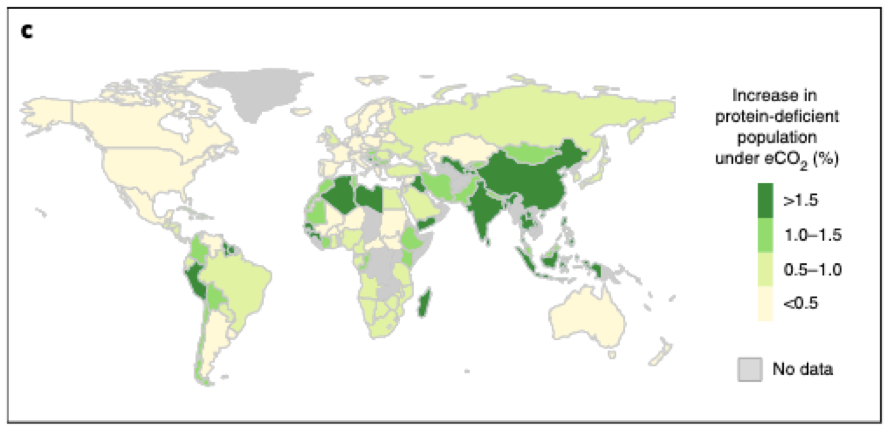
Source: Smith and Meyers, 2018.
[1] E.g. Berners-Lee et al. 2018; Ranganathan et al. 2016.
[2] Smith MJ, Meyers SS, ‘Impact of global CO2 emissions on global human nutrition’, Nature Climate Change, 8:834-839, 2018.
[3] Lesk C et al., ‘Compound heat and moisture extreme impacts on global crop yields under climate change’, Nature Reviews Earth & Environment 3, December, 872-889, 2022.
[4] Ibid.